
 Back to News & Press
Maine Public: Western Maine conservation project offers ‘ecologically important’ reprieve for wildlife
July 30, 2026
From Maine Public | Written by Susan Sharon
In the Rangeley Lakes region of western Maine, several conservation groups have permanently protected 78,000 acres around the Magalloway River watershed from development.
Heavily forested, with a cold water fishery, this is an ecologically important landscape that still feels remote and wild. It has one of the last sustaining brook trout populations in the country, so it’s a fly fishing haven. But it’s also a popular birding destination. And there’s a major snowmobile corridor that cuts through the woods linking Maine with New Hampshire.
Even more significant for wildlife facing climate change is that the Magalloway parcel connects with half a million acres that have previously been conserved.
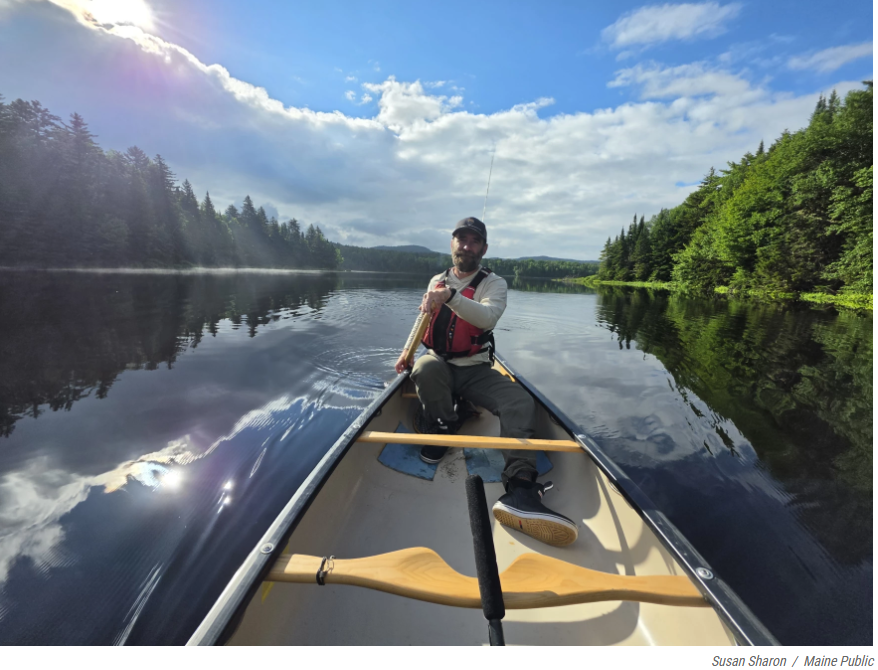
On a sparkling early morning in June, Seth Laliberte and I settle into his canoe at the northern end of Aziscohos Lake not far from the Big Magalloway and Little Magalloway rivers. Laliberte says there’s a long history here of people coming in search of trophy brook trout, but he says the salmon fishing is not bad either.
A school principal, Laliberte also doubles as a registered Maine guide. He and his wife own an outdoor sporting goods store in Rangeley. And he’s a rabid paddling enthusiast. He thinks it’s one of the best ways to explore the North Woods.
“It’s easy and it’s accessible for a lot of people,” he says. “It’s just a peaceful way to move around the land.”
Aziscohos Lake is narrow and and 20 miles long, surrounded by rolling mountains covered with trees. It’s still and quiet. The shoreline is almost entirely undeveloped. But there’s plenty of wildlife to be seen and heard. We paddle past a pair of loons, watch a kingfisher in a streak of blue nosedive into the lake to retrieve a fish, observe an eagle perched on a tall spruce and move quietly into a cove to record a chorus of green frogs that sound like someone is tuning a guitar. If we’re lucky we might get to see a moose.
“Even on a day when it’s not this perfect, it’s still amazing,” Laliberte says. “I always tell people … this is kind of what it looked like forever.”
Despite the picture perfect scene, Maine’s North Woods are under pressure, from forest fragmentation and development, including from wealthy landowners looking to purchase their own slice of heaven and close it off for their personal enjoyment. And then there’s the threat of climate change and what that means for plants and animals already confronting habitat loss.